Optimizing Thermal Storage for Peak Load Management
Strategic approaches to implementing thermal storage solutions that enhance system efficiency and reduce operational costs during peak demand periods.
Why Thermal Energy Storage is a Smart Play for Peak Load Management
Peak load management isn't just a utility problem anymore—it's everyone's problem. As electricity demand climbs, especially with the surge in data centers and the shift to electrified buildings, the grid gets pushed to its limits. When demand spikes, utilities often fire up inefficient peaker plants—expensive, dirty, and blunt-force solutions to a demand profile that we could be smoothing with smarter tools.
Enter thermal energy storage (TES). It's not new, but it's evolving—and it's one of the few energy technologies that doesn't just sit on the sidelines during peak hours. It steps in. Whether it's storing heat in the winter or cold in the summer, TES gives buildings and districts the option to consume energy when it's cheap and clean, and hold onto it for when it's not.
The Real Problem with Peak Demand
Peak demand hurts in two ways: it destabilizes the grid and it punishes the customer. Demand charges make up a significant portion of commercial electricity bills. Meanwhile, the mismatch between when we generate renewable energy and when we use it (solar at noon vs. peak demand at 6 PM) leaves utilities scrambling. That solar electricity doesn't help much if you can't shift it.
Thermal energy storage solves that. It doesn't need to convert electricity into batteries and back again. It just holds onto the energy—hot or cold—and uses it when the building needs it most. It's simple physics, and when implemented right, it's brutally effective.
What Is TES Actually Doing?
Think of TES as a thermal battery. Instead of charging with electrons, it charges with heat or cold—either by raising the temperature of water (sensible heat), melting or freezing a phase change material (latent heat), or initiating reversible chemical reactions (thermochemical). Each one has a different use case, temperature range, and economic profile. Here's how they stack up:
Sensible heat is cheap and proven—think water tanks and molten salt. Latent heat is compact and works at steady temperatures—ideal for space-constrained buildings. Thermochemical is the space-age option with high density and minimal loss over time—but it's still maturing.
Why This Works in Buildings
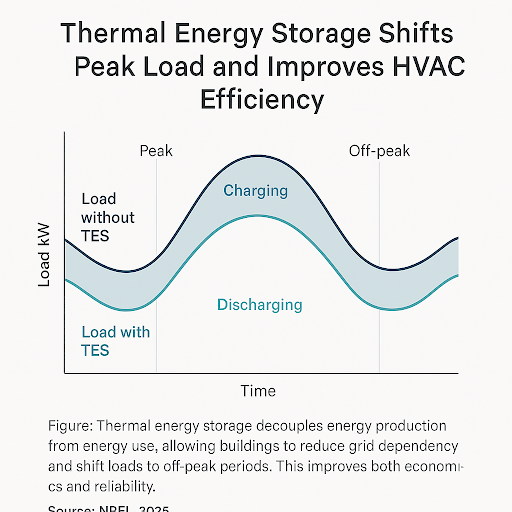
Buildings with large thermal loads are perfect for TES. You store energy at night when rates are low. Then during the day—when your HVAC system would normally crank—TES kicks in. That means you're not drawing on the grid at its most stressed (and expensive) time. That's peak shaving in action.
Ice storage is already doing this in commercial buildings. Data centers and supermarkets are using their inherent thermal mass as load buffers. In Europe, even district heating systems are now integrating hot water tanks and pit storage to absorb waste heat and flatten load profiles.
Let's be real: this only pencils out if the price spread between peak and off-peak is significant. But when it is, the economics are hard to beat. And with demand charges and time-of-use pricing spreading globally, that's increasingly the case.
When TES Meets CHP and District Systems
The magic really happens when you combine TES with combined heat and power (CHP) or district systems. Now you're stacking benefits: running your generation asset when prices are high, storing excess heat, and decoupling your generation from demand.
Take the Friedrichshafen system in Germany. By pairing solar with TES, they cut annual gas consumption by 30% and emissions by 46%. Or SUNY Purchase—where a TES + microturbine system dropped emissions by 550 metric tons of CO₂e annually. These aren't pilot projects anymore. They're working examples.
Why You Should Care
If you're designing for decarbonization, resilience, or just plain economics, you can't ignore TES. With energy volatility increasing, having a buffer gives you leverage. With grid capacity getting tighter, storing heat or cold lets you play offense instead of defense. It's not just about smoothing peaks—it's about strategic control of when and how you consume energy.
Related Articles
Exploring how advanced heat pump systems are revolutionizing district energy networks and enabling low-carbon heating and cooling solutions.
An in-depth look at the design and implementation of the 51,000 MBH heat pump district heating plant and its impact on urban sustainability.