Electrification Strategies for Existing Commercial Buildings
Practical approaches to transitioning existing commercial buildings from fossil fuel-based systems to electric alternatives while minimizing disruption.
The Electrification of Existing Commercial Buildings: Why It Matters and How to Get It Right
Electrifying existing commercial buildings isn't just a sustainability trend—it's becoming an operational necessity. The pressure is mounting from all sides: carbon regulations are tightening, tenants are demanding low-carbon spaces, and electric technology has matured to a point where full-building electrification is not only feasible but economically advantageous. However, too many building owners are still hesitant—often misjudging the true cost, disruption, or long-term value this shift can unlock.
Buildings Are Emission Giants—But That's Also an Opportunity
Commercial buildings account for around 16% of U.S. greenhouse gas emissions (NREL, 2025). They burn fossil fuels for heating, hot water, and cooking—releasing carbon, polluting indoor air, and tying owners to volatile fuel prices. Electrification offers a cleaner pathway, especially as the grid decarbonizes. When paired with renewables, the emissions impact is even greater—modeling shows up to 70% reductions by 2050.
But decarbonization isn't just about optics. It's about risk management. Properties running on fossil fuels will face higher retrofit costs, carbon penalties, and tenant attrition as ESG pressures grow.
The Dollars Make Sense—Especially Long Term
There's a lingering myth that electrification is financially out of reach. Not true. Heat pumps, for instance, can cut heating/cooling energy use by 20–50% (Better Buildings, 2025). That's not a rounding error—it's a major OPEX shift.
Maintenance costs drop, too. Combustion systems are complex, failure-prone, and costly to maintain. Electric systems are simpler and modular.
And let's talk asset value: sustainability-aligned buildings command higher rents—anywhere from 2% to 17% premiums (CIM, 2025). Plus, they sell faster and attract higher-tier financing. That's cash in your pocket—not just ESG fluff.
The Strategy That Works: Electrify the Right Things First
It's not about ripping out every gas line tomorrow. Strategic, phased implementation is the key:
- Start with HVAC: Heat pumps—air-source, water-source, or geothermal—are mature, scalable, and can serve heating and cooling from a single unit. If full replacement isn't practical, hybrid systems or VRF retrofits still get you most of the way there.
- Water heating: HPWHs are a no-brainer for high-efficiency, especially in high-demand commercial setups. Centralized or tankless options can be tailored per building size.
- Kitchens and appliances: Induction cooktops bring higher efficiency, better indoor air quality, and speed. Heat pump dryers and electric laundry systems follow naturally.
- Backup power: Consider replacing diesel generators with batteries paired with solar—especially in regions with incentive programs.
Don't Ignore the Load Profile—Thermal Energy Storage Can Tilt the Economics
One key enabler for electrification is load shifting. Thermal Energy Storage (TES) systems let you store heating or cooling when electricity is cheap (off-peak) and deploy it when it's expensive or grid-strained.
That means:
- Smaller HVAC system sizes
- Reduced peak demand charges
- Better grid integration
TES makes heat pumps more effective during extremes. When done right, it becomes the control center of your energy strategy.
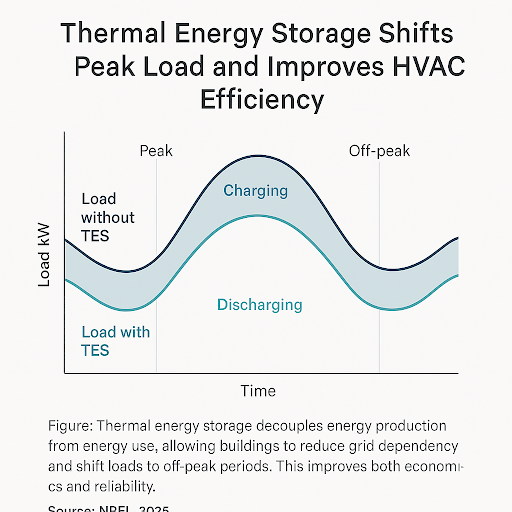
Figure: Thermal energy storage decouples energy production from energy use, allowing buildings to reduce grid dependency and shift loads to off-peak periods. This improves both economics and reliability. (Source: NREL, 2025)
Success Is Happening—You Just Need the Right Playbook
Nova Scotia's Net-Zero Industrial Centre and the repurposed Halifax coal plant turned LEED Platinum HQ prove this isn't theoretical. They integrated heat pumps, tight envelopes, and TES—cutting emissions while boosting resilience and ROI.
The lesson? Electrification isn't one-size-fits-all. But it is absolutely achievable—if planned carefully.
What's Holding Us Back (and How to Push Through)
- Infrastructure: Older buildings may need panel upgrades or new service connections. That's where smart load management comes in—shaving peaks and controlling schedules.
- Upfront costs: Incentives, C-PACE financing, and ESPCs are unlocking access. Many utilities now offer on-bill financing to spread costs without CAPEX shock.
- Workforce readiness: Partner with firms that understand heat pump logic, TES design, and retrofit constraints. Train contractors early.
- Tenant-owner split: Green leases or cost-sharing agreements help align incentives. Everyone wins when energy use drops.
Final Thoughts: It's Time to Electrify, Not Later—Now
Electrifying commercial buildings is not just better for the planet—it's smarter for your bottom line. Done strategically, it means lower operating costs, healthier buildings, and assets that retain long-term value in a decarbonizing economy.
So here's the ask: Are you ready to future-proof your building?
Feel free to reach out and let me know what roadblocks you're facing—or where you've already made progress. Contact me
Related Articles
A comprehensive overview of current and upcoming carbon reduction policies and how facility managers can prepare their infrastructure for compliance.
Exploring how advanced heat pump systems are revolutionizing district energy networks and enabling low-carbon heating and cooling solutions.